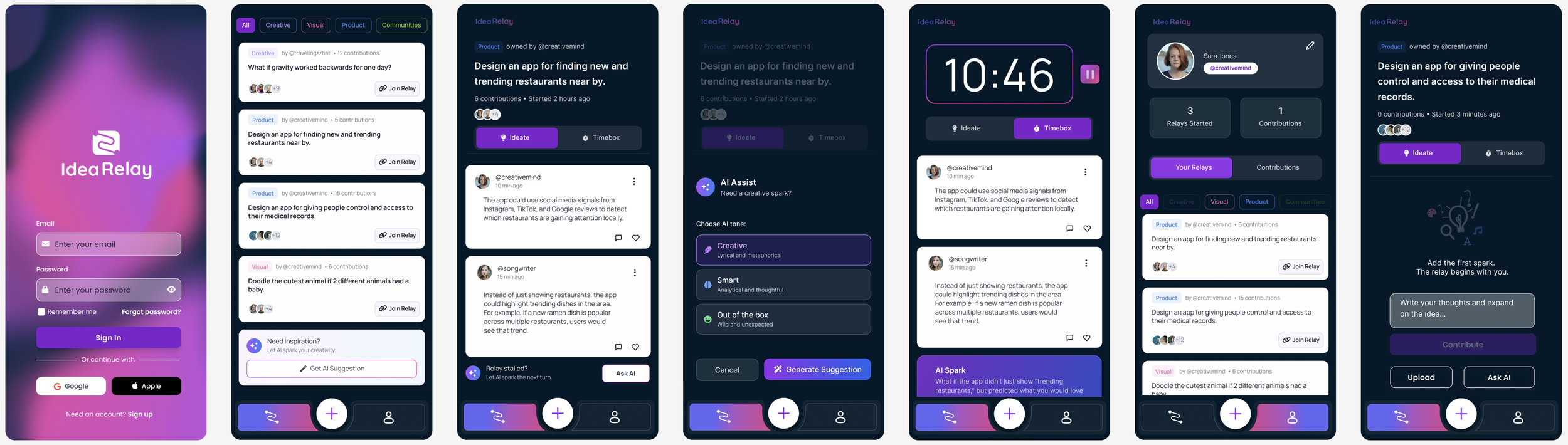
Idea Relay
A collaborative platform where ideas evolve through community input
Role
Senior product designer
Scope
UX strategy, Interaction design
Platform
Mobile
The Problem
Creative work often begins with a spark, but many ideas stall before they fully develop.
Creators frequently experience:
Blank canvas anxiety when starting new ideas
Analysis paralysis when evaluating multiple directions
Siloed thinking without outside perspectives
Most brainstorming tools either impose rigid frameworks or bury ideas in long discussions, making it difficult for ideas to evolve collaboratively.
The Opportunity
Creative teams often rely on scheduled brainstorming sessions to generate ideas. While useful, these sessions can be inconsistent, dominated by a few voices, and difficult to sustain outside of meetings.
Many existing collaboration tools focus on task management or documentation rather than early-stage ideation.
Idea Relay explores how a digital platform could support continuous, low-pressure idea sharing, allowing teams to contribute ideas over time and build on each other’s thinking.
Research
I researched to understand how people approach ideation and collaboration, also analyzing how competitors approached that same problem.
User Interviews
I conducted interviews with 8 participants across creative and product roles, including:
Product designers
Product managers
Creative writers
Participants were asked questions such as:
How do you typically capture new ideas?
What tools do you currently use for brainstorming?
What makes brainstorming sessions successful or unsuccessful?
How do you build on ideas with others?
What challenges do you encounter when collaborating on ideas?
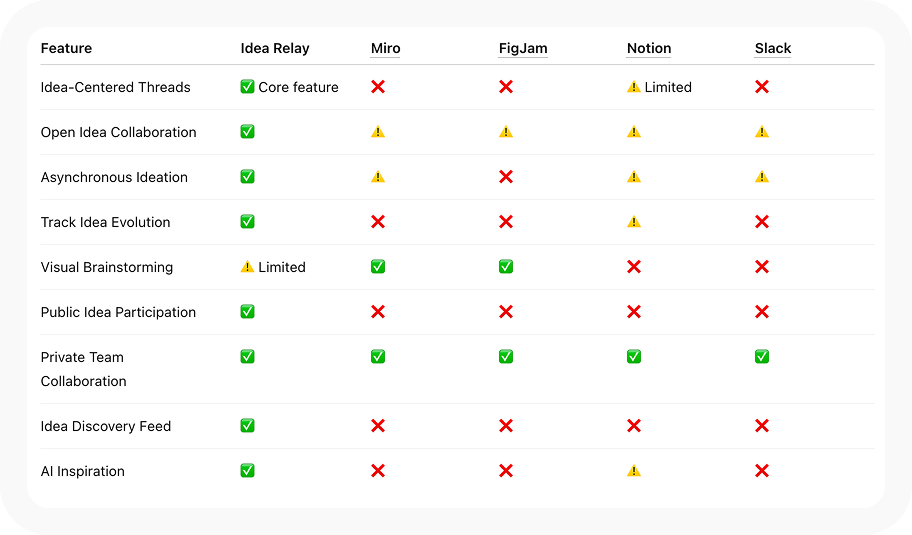
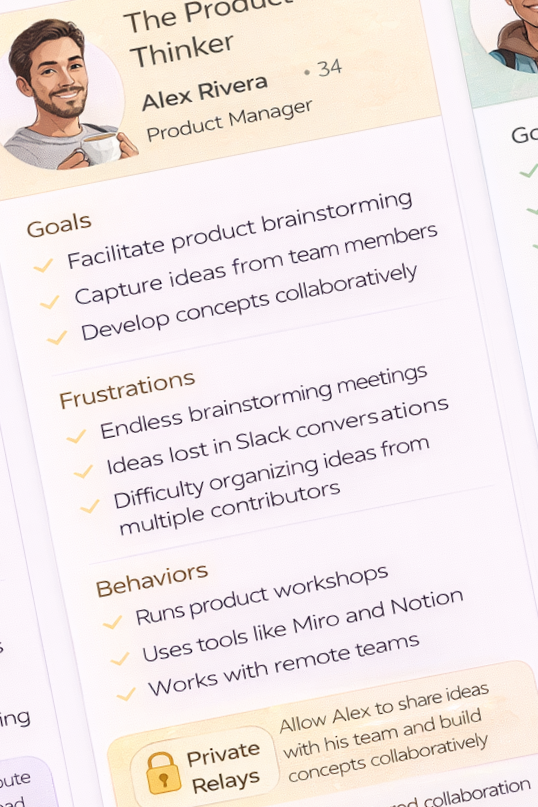
Several patterns emerged:
• Brainstorming sessions often favored the most vocal participants
• Contributors felt pressure to present polished ideas
• Many ideas were forgotten between meetings
Participants expressed interest in a tool that would allow them to capture and develop ideas more organically.
Creative ideation works best when it feels iterative and collaborative rather than performative.
Participants were more willing to contribute when ideas could be rough, incomplete, and expanded by others.
Key Insights
Getting started is the hardest part
Many participants described experiencing blank canvas anxiety when starting new ideas.
Several said they preferred contributing to ideas that already existed.
“It’s easier to improve an idea than to start one from scratch.”
This insight led to emphasizing idea threads rather than isolated idea posts.
Creativity improves with other perspectives
Participants reported that new perspectives often helped unlock new directions.
Seeing how others approached the same idea frequently sparked additional creativity.
“Someone else’s comment can completely change how I think about an idea.”
This reinforced the importance of open collaborative contributions.
Ideas lose energy when they sit idle
Many ideas were described as stalled sitting idle until someone has they time to do the work.
Participants wanted a way for ideas to continue evolving even when collaborators were working asynchronously.
“Ideas get buried in chats and then no one comes back to them.”
This insight informed the design of visible idea threads and contribution activity.
Exploring the Concept
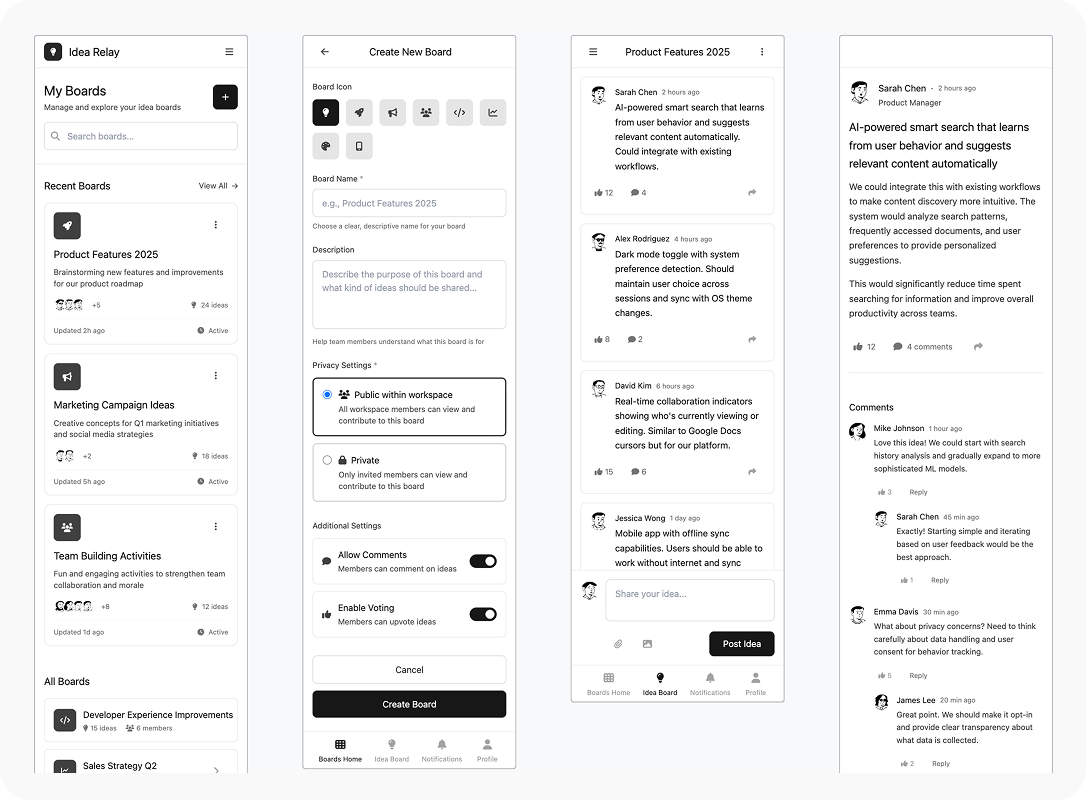
Shared idea board
Users posted ideas to a shared board where others could comment.
While familiar, this did not encourage ongoing idea development and I felt that it lacked organization.
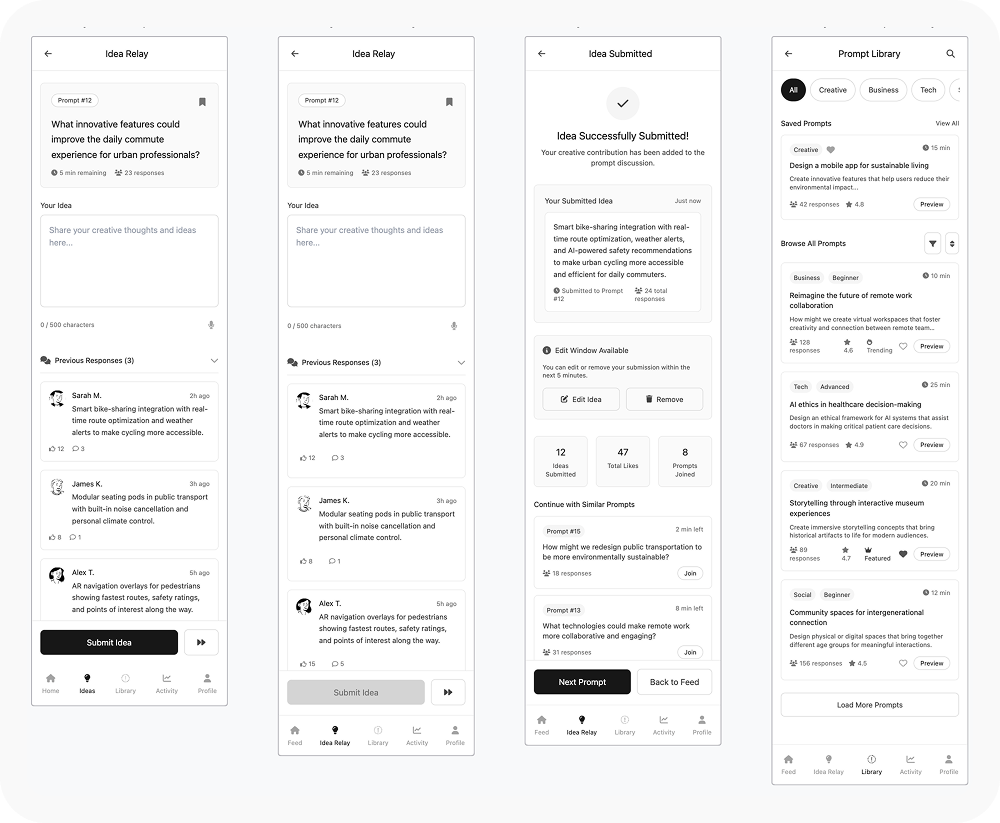
Prompt-based brainstorming
Users responded to structured prompts designed to spark creativity.
This approach limited how ideas could evolve collaboratively. Instead we felt we can take inspiration from the prompts for when there was a roadblock.
Relay-based ideation
Users would interact in a relay structure where ideas could be passed from one contributor to another.
Each participant adds, refines, or evolves the idea, allowing concepts to grow through collective input.
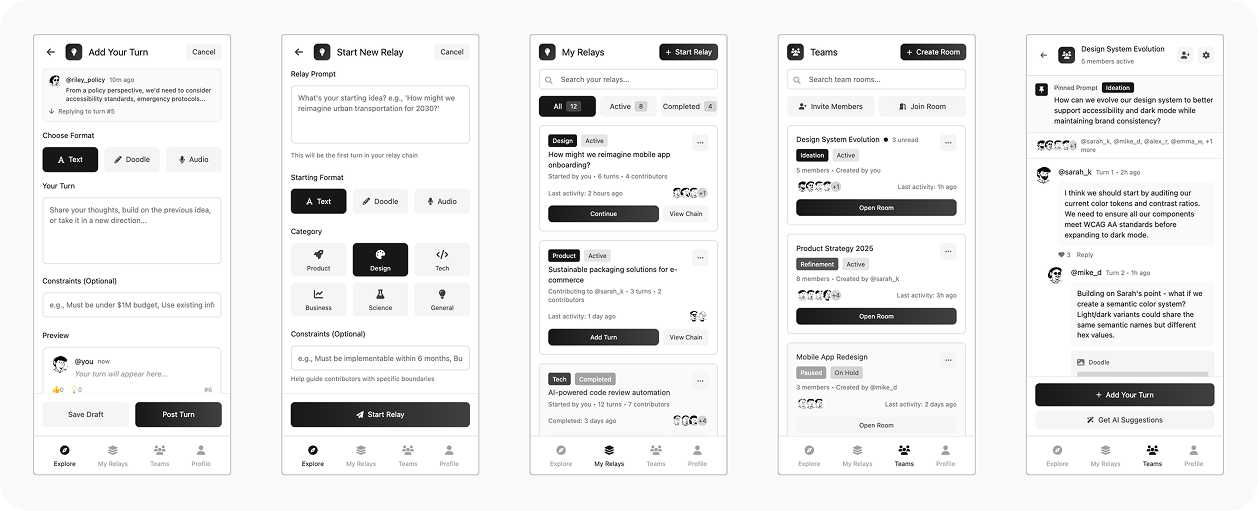
We selected relays to be our foundation as it created the most momentum and most effective evolution of ideas in a group dynamic.
The Solution
A mobile platform where users post ideas and open them to collaboration.
Contributors can respond freely by:
Contributing features
Sharing insights
Asking questions
Refining concepts
Uploading sketches or media
Ideas evolve organically through collaborative discussion rather than structured workflows.
Key Features:
Idea threads
Every idea becomes a collaborative thread where contributors build on the original concept.
Public or private relays
Ideas can be shared with a public community or restricted to invited collaborators.
Contribution feed
Users discover active relays through a feed showing trending ideas, contributor activity, and recent updates.
AI inspiration
When discussions slow down, AI prompts help spark new contributions and maintain creative momentum.
Outcomes
Beta testing showed that the open collaboration model:
Increase spontaneous idea sharing
Reduced participant pressure compared to structured brainstorming
Increased engagement in asynchronous discussions
78% of participants enjoyed seeing how ideas evolved through multiple perspectives.
Reflection
Creativity often thrives in flexible environments.
By removing rigid brainstorming frameworks, Idea Relay focuses on idea evolution rather than idea generation, enabling collaborative thinking that grows concepts through shared input.